How to build a GEO dashboard for your clinic without paid tools
Published on October 15, 2026
Metrics and Monitoring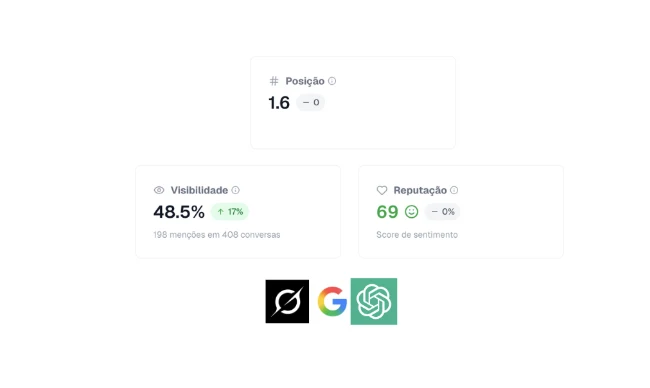
A paid tool is not a mandatory requirement to measure your visibility in AI assistants. To build a GEO dashboard without spending anything, you need three things: a fixed list of questions patients ask, a spreadsheet to record the answers and a weekly testing routine on ChatGPT, Gemini and Perplexity. The spreadsheet becomes your control panel.
At Bincoo, we monitor thousands of clinics and see a clear pattern: those who measure, improve. Those who don't measure don't even know if they're losing patients.
More than 10,000 companies already use Bincoo to be recommended by ChatGPT, Gemini and other platforms.
What goes in your control panel
A GEO dashboard answers four questions:
- Does my clinic show up? Direct mention in the answers;
- In what position? First recommended, cited in the middle or only listed at the end;
- How does it appear? Positive, neutral mention or with wrong information;
- Who appears in my place? The competitors cited instead of your clinic.
If your spreadsheet answers these four questions per week, you already have a working dashboard.
Step by step: building it in 5 stages
1. List 15 to 20 real patient questions
Use what you hear at the front desk and on WhatsApp: "best dentist in [city]", "implant clinic with good price", "orthodontist for adults near me". These are the same phrases the patient types into the AI.
2. Create the spreadsheet with simple columns
Suggested minimum structure:
| Date | Question | AI | Cites your clinic? | Position | Sentiment | Competitor cited |
|---|---|---|---|---|---|---|
| 15/10/2026 | best dentist in Campinas | ChatGPT | Yes | 2nd | Positive | Alfa Clinic |
| 15/10/2026 | best dentist in Campinas | Gemini | No | — | — | Alfa Clinic |
3. Run the questions every week on the same day
Repeat each question on ChatGPT, Gemini and Perplexity. Record the result right away. Don't trust your memory: today's answer changes tomorrow.
4. Calculate two monthly indicators
Add up how many answers cited you and divide by the total number of questions: that's your visibility percentage. Add up how many times each competitor appears: that's your local share of voice.
5. Create an alerts tab
Every time wrong information appears (old address, a specialty you don't offer, an outdated phone number), note it in a separate tab. These errors deserve immediate action.
What the spreadsheet doesn't catch (and the tool does)
The manual method works, but it has limits you need to know:
| Capability | Manual spreadsheet | GEO platform |
|---|---|---|
| Automatic history | You type everything | Continuous collection |
| Question scale | 15 to 20 per session | Hundreds of variations |
| Competitor comparison | Manual | Automatic |
| Sentiment analysis | Human eye | Classified by AI |
| Drop alert | You notice on your own | Immediate notification |
If your time is worth more than one hour a week, automation pays for itself. On the Essential plan, at R$ 39.00/month, Bincoo collects AI answers automatically, builds the history and shows your clinic's share of voice against competitors in your city.
Common mistakes in the handmade dashboard
- Changing the questions every week: then you lose comparability. Fix the list and review it only once a month;
- Testing only on ChatGPT: each AI reads different sources, and Gemini's answer often differs from ChatGPT's;
- Recording only when you appeared: the "no" is the most important data point, because it shows the size of the problem;
- Doing it once and abandoning it: a dashboard without routine is decoration, not a tool.
Conclusion
- A GEO dashboard fits in a spreadsheet: fixed questions, weekly tests, four recording columns;
- Measure position, sentiment and cited competitors, not just "did I show up or not";
- When scale outgrows manual work, automate with a dedicated platform.
Want to skip the spreadsheet and see your panel ready? access Bincoo and start monitoring today.
Frequently asked questions
"Can you measure AI visibility without paying for a tool?"
Yes. You need a free spreadsheet, a fixed list of patient questions and the discipline to repeat the test every week on ChatGPT, Gemini and Perplexity. What a paid tool adds is scale, automatic history and sentiment analysis.
"How long does the weekly test take?"
Between 30 minutes and 1 hour, depending on how many questions you monitor. With 15 to 20 well-chosen questions, you cover 80% of what patients ask.
"Which AI assistants should I monitor at first?"
Start with ChatGPT, Gemini and Perplexity. They answer differently from one another and together represent the majority of patient queries.
"When is it worth paying for a GEO platform?"
When the volume of questions exceeds what you can check by hand, when you want to compare against competitors at scale, or when you need automatic history. For clinics, Bincoo does this full monitoring starting at R$ 39.00/month (Brazilian reais).