How to measure AI visibility: the metrics that matter in 2026
Published on September 29, 2026
Metrics and Monitoring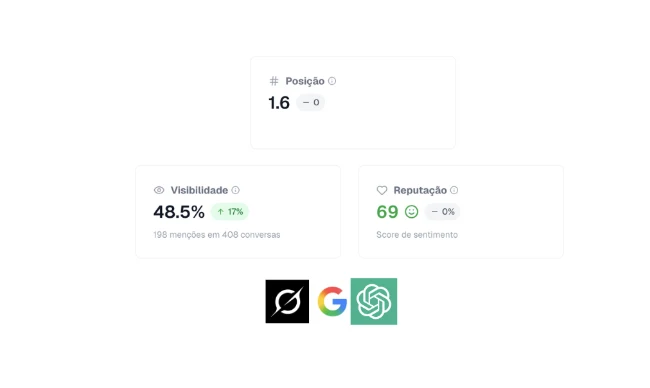
You can't improve what you don't measure. To measure your AI visibility in 2026, you need to track four numbers every week: how often your clinic is mentioned, how often it's recommended, the position it appears in, and how much of your market's share of voice is yours. That dashboard is what separates those who show up on ChatGPT from those who just imagine they do.
At Bincoo, while monitoring thousands of clinics every week, we've seen a clear pattern: those that measure visibility monthly grow citations twice as fast as those that don't. The difference isn't effort, it's direction.
More than 10,000 companies already use Bincoo to be recommended by ChatGPT, Gemini and other platforms.
Why Google Search Console is no longer enough
Search Console shows impressions and clicks on Google. It doesn't show how many times Gemini answered with your competitor's name to a potential patient. AIs are becoming a parallel search, with their own ranking, their own sources and their own rules. Measuring only Google today means measuring half of the patient's journey.
The four metrics that matter
| Metric | What it measures | Why it matters |
|---|---|---|
| Mention rate | % of prompts where your clinic is cited | Shows whether the AI knows you exist |
| Recommendation rate | % of prompts where you're pointed to as an option | It's the metric that generates patients |
| Average position | The order you appear in when cited | Appearing first drives far more traffic |
| Share of voice | Your slice of citations against competitors | Shows whether you're winning or losing market |
In practice, these four metrics answer the question every clinic owner asks: why does Gemini recommend my competitor and not me?
It's also worth tracking two context indicators: the prompts won and lost in the week, and the tone of the answers you appear in. A mention inside an answer about complaints is not a win, it's a warning. And going from 10% to 15% recommendation in a month means far more patients than the Google position fluctuation you usually celebrate.
How to build your visibility dashboard in 5 steps
- List the 20 to 30 prompts your patients would ask, like 'best implant clinic in [your city]' and 'how much do dental contact lenses cost'.
- Run those prompts every week on ChatGPT, Gemini and Perplexity, saving the answers.
- Record mentions, recommendations, position and competitors cited in each answer.
- Calculate the rates and compare with the previous week to see the trend.
- Act on the gaps: if you don't appear in a prompt, publish content that answers exactly that question.
The hardest step isn't technical, it's consistency. Doing this by hand every week wears you down, and that is exactly why Bincoo exists.
The mistakes that invalidate your measurement
Before trusting the numbers, avoid traps that distort the dashboard:
- Running the prompts once and drawing conclusions: AIs vary answers between runs, so a single test measures nothing. Use the weekly average.
- Testing only ChatGPT: Gemini uses other sources and answers differently. A clinic can have 40% visibility on ChatGPT and 5% on Gemini.
- Using generic questions: a monitoring prompt needs to mirror the patient's real speech, with city, treatment and intent.
- Mixing mention with recommendation: adding the two together hides the metric that generates patients.
What Bincoo measures for you
The platform runs your prompts every week on the leading AIs, calculates the four metrics above and delivers a report with what changed, which prompts you won or lost and the action plan to recover ground. On the Essential plan, at R$ 39.00/month, you already get the full dashboard, no lock-in.
Conclusion
- Measuring AI visibility requires four metrics: mention, recommendation, position and share of voice.
- Monitoring needs to be weekly, because AI answers change fast.
- Automating the measurement is what guarantees consistency and fast action on drops.
Stop guessing and start seeing your real numbers on AIs: access Bincoo and run your first visibility report this week.
Frequently asked questions
"How do I know if my clinic shows up in ChatGPT's answers?"
Ask the questions your patients would ask, note whether your clinic is cited and which competitors it was replaced by. The ideal is to automate this: Bincoo runs your key terms every week on ChatGPT, Gemini and other AIs and shows you on a dashboard whether you appear more or less.
"What's the difference between a mention and a recommendation in AI?"
A mention is when the AI cites your clinic's name in some context. A recommendation is when it points to your clinic as an option for the person asking. Recommendations are worth much more, because that is what converts into a patient.
"How many prompts should I monitor per week?"
Between 20 and 30 prompts cover most clinics well: variations of best clinic in town, treatment prices, comparisons with competitors and patient questions. Bincoo generates that list automatically from your niche.
"Can AI visibility drop out of nowhere?"
Yes. Model changes, outdated content or a competitor publishing more can sink your citations within a few weeks. That's why weekly monitoring is essential, with a drop alert.
"Where can I see these metrics without manual spreadsheets?"
In the Bincoo dashboard: visibility, share of voice, recommendations, average position and the prompts won and lost in the week. The [Essential plan, at R$ 39.00/month](/pt/planos) already includes the full weekly report.