Before and after: how to prove GEO ROI for clinics
Published on October 15, 2026
Metrics and Monitoring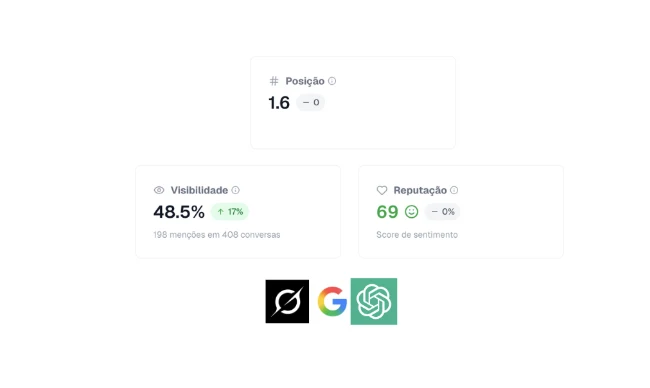
GEO returns are not a matter of faith: they are a matter of records. To prove GEO ROI, document the before (what the AIs answered on day zero), measure the after (citations and position month over month), and connect the two to the patients who arrive saying the AI recommended you. With that trail, any clinic owner understands the value.
At Bincoo, we track the evolution of thousands of clinics, and the before and after always follows the same format: visibility rises first, patients arrive later, revenue closes the account.
More than 10,000 companies already use Bincoo to be recommended by ChatGPT, Gemini, and other platforms.
The problem: AI leaves no link to track
On Google, you see the click. On AIs, the patient receives the recommendation and calls directly, books via WhatsApp, or searches for the clinic's name later. The conversion path is invisible to traditional analytics, which is why many people think it cannot be measured. It can, but it requires combining three sources:
- Citation log: how many answers cite the clinic and in what position;
- Front-desk log: a standard question about origin, with an AI option;
- Average ticket per procedure: to convert patients into reais.
Day zero: building the before
Before any investment, record the current state. Run these questions on ChatGPT, Gemini, and Perplexity and save the answers:
- Best [specialty] in [city];
- [Main procedure] clinic with good price;
- [Specialty] near me;
- Who does [treatment] in [neighborhood]?
- Is [your clinic's name] good?
Note whether it appeared, in what position, with what tone, and which competitors were cited. That is your "before," and it is worth its weight in gold in the results meeting.
The after: what to measure every month
| Metric | Tool | What it proves |
|---|---|---|
| Citation rate on AIs | Weekly monitoring | Growing visibility |
| Average position in answers | Weekly monitoring | Quality of visibility |
| Patients with AI origin | Front-desk log | Real demand generated |
| Revenue from AI patients | Billing per patient | Financial return |
| Monthly GEO cost | Platform + content | Total investment |
A realistic calculation example
Imagine a dental clinic that invests in GEO and, after three months, appears in the top answers for its city. In the fourth month, the front desk logs 6 AI-sourced patients, of whom 2 close implants at R$ 4,500 each and 4 get treatments at R$ 900 each. Attributable revenue: R$ 12,600. If the program's monthly cost, including platform and content, is R$ 500, that month's return is more than 25 times the investment.
The point is not to promise that number to everyone: it is to show that the math exists and is simple. A single high-value procedure already pays for the entire year's investment.
How to present the after to partners
In the meeting, show the visual comparison first: the AI answers from day zero side by side with today's. Nothing convinces a clinic owner more than seeing their own clinic appear in an answer where before there were only competitors. Then comes the financial table, with the period's investment and attributed revenue. In that order, the argument builds itself: first the visible proof, then the math.
Mistakes that distort the calculation
- Attributing everything to AI at once: compare against the day-zero baseline, not against memory;
- Forgetting the cost of time: your team's hours at the front desk and producing content count;
- Measuring only the first month: GEO is a medium-term game, a 90-day cutoff kills any proof;
- Not asking about origin at the front desk: without that habit, the most important part of the after is lost.
Conclusion
- Document day zero with screenshots and notes of the AI answers;
- Measure citations monthly and patients via the front desk, with the origin question;
- Close the account: revenue from AI patients against the program's total cost.
Want to see your clinic's before and after documented automatically? access Bincoo and start with monitoring.
Frequently asked questions
"How do I calculate GEO ROI for a clinic?"
Add up the monthly GEO investment (platform, content, and team hours) and compare it with the revenue from patients who arrived via AI. If one implant generated by an AI referral bills R$ 5,000 and the monthly cost is R$ 39, the return is easy to defend.
"What is the first step to proving the before and after?"
Document the baseline: on day zero, record what ChatGPT, Gemini, and Perplexity answer about the main questions for your specialty and city. Without that record, there is no comparison.
"How long until GEO pays for itself?"
In the clinics we monitor, the first AI-sourced patients appear between 4 and 12 weeks after the optimized publications begin. Full returns usually arrive between the third and sixth month.
"How do I know where a patient came from if AI leaves no trace?"
Through the front desk. Train your team to ask how the patient heard about the clinic and to note the channel: Google, referral, Instagram, or AI. Since many patients spontaneously report that AI recommended you, the question captures almost everything.